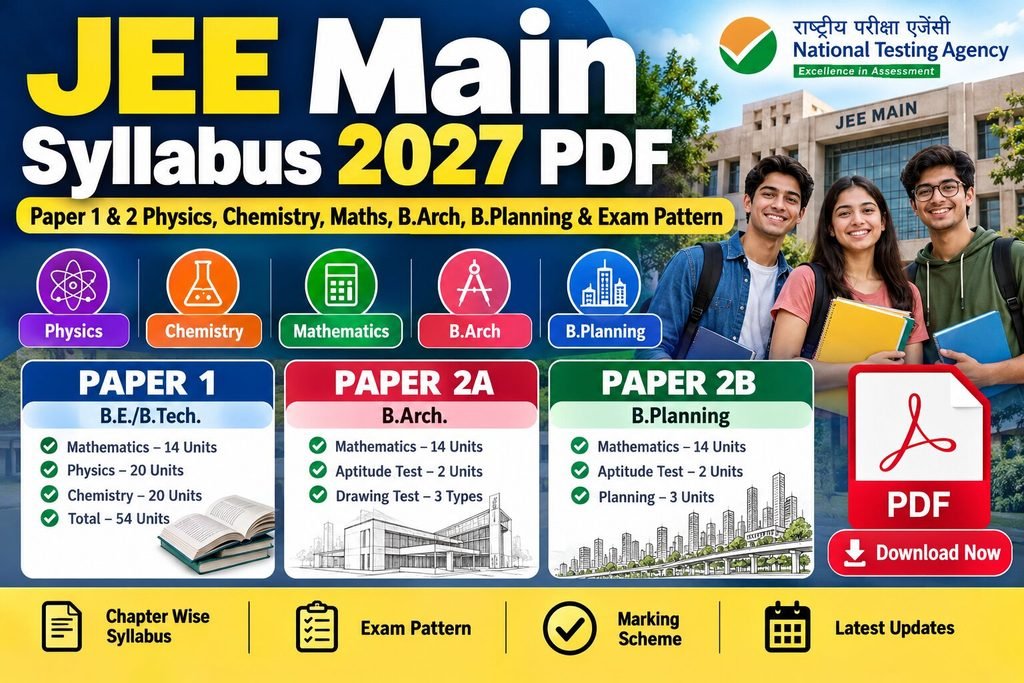
The National Testing Agency (NTA) has opened registrations for JEE Main 2027, and it has also released the official syllabus and exam pattern. Candidates seeking admission to B.Tech, B.E., or B.Arch. programs should study the syllabus thoroughly. To succeed in any national-level competitive examination, it is essential to have a detailed understanding of the latest exam pattern, marking scheme, and the topic-wise syllabus. On this page, we will discuss in detail the JEE Main Paper 1, Paper 2A, and Paper 2B—covering their topic-wise syllabi, exam patterns, and how to download them in PDF format.
JEE Main Syllabus 2027 Overview
| Description | Information |
|---|---|
| Exam Name | Joint Entrance Examination (Main) 2027 (Session 1) |
| Conducting Agency | National Testing Agency (NTA) |
| Post Category | JEE Mains 2027 Syllabus, Exam Pattern |
| Paper 1 | B.E./B.Tech. |
| Paper 2A | B.Arch. |
| Paper 2B | B.Planning |
| Official Syllabus Status | Released |
| Official website | jeemain.nta.nic.in |
JEE Main Syllabus 2027 Paper 1 – B.E./B.Tech.
For JEE Main 2027, the first session of the examination is scheduled for January 2027, while the second session will take place in April 2027. JEE Main Paper 1 is intended for students who wish to seek admission into B.E. and B.Tech courses. It covers three core subjects: Mathematics, Physics, and Chemistry. The syllabus consists of a total of 54 units. The topics for each unit within these subjects are provided below.
JEE Main Mathematics Syllabus 2027 – 14 Units
| Unit | Chapter | प्रमुख Topics |
|---|---|---|
| 1 | Sets, Relations and Functions | Sets, Relations, Functions |
| 2 | Complex Numbers and Quadratic Equations | Complex Numbers, Roots, Quadratic Equations |
| 3 | Matrices and Determinants | Matrix Operations, Determinants, Inverse |
| 4 | Permutations and Combinations | Counting Principle, Permutations, Combinations |
| 5 | Binomial Theorem | Binomial Expansion, General Term |
| 6 | Sequence and Series | Arithmetic and Geometric Progressions |
| 7 | Limit, Continuity and Differentiability | Limits, Derivatives, Applications |
| 8 | Integral Calculus | Indefinite and Definite Integrals |
| 9 | Differential Equations | Order, Degree, Solutions |
| 10 | Coordinate Geometry | Straight Lines, Circles, Conic Sections |
| 11 | Three-Dimensional Geometry | Coordinates, Lines in Space |
| 12 | Vector Algebra | Vectors, Scalar and Vector Products |
| 13 | Statistics and Probability | Mean, Variance, Probability |
| 14 | Trigonometry | Identities, Functions, Inverse Trigonometry |
JEE Main Physics Syllabus 2027 – 20 Units
| Unit | Chapter |
|---|---|
| 1 | Units and Measurements |
| 2 | Kinematics |
| 3 | Laws of Motion |
| 4 | Work, Energy and Power |
| 5 | Rotational Motion |
| 6 | Gravitation |
| 7 | Properties of Solids and Liquids |
| 8 | Thermodynamics |
| 9 | Kinetic Theory of Gases |
| 10 | Oscillations and Waves |
| 11 | Electrostatics |
| 12 | Current Electricity |
| 13 | Magnetic Effects of Current and Magnetism |
| 14 | Electromagnetic Induction and Alternating Currents |
| 15 | Electromagnetic Waves |
| 16 | Optics |
| 17 | Dual Nature of Matter and Radiation |
| 18 | Atoms and Nuclei |
| 19 | Electronic Devices |
| 20 | Experimental Skills |
Physics Topic
Mechanics
- Motion
- Force
- Work
- Energy
- Rotational Motion
- Gravitation
Heat and Thermodynamics
- Heat Transfer
- Thermodynamics
- Kinetic Theory of Gases
Electricity and Magnetism
- Electric Field
- Current Electricity
- Magnetic Effects
- Electromagnetic Induction
Optics
- Reflection
- Refraction
- Lenses
- Interference
- Diffraction
Modern Physics
- Photoelectric Effect
- Atoms
- Nuclei
- Semiconductor Devices
- Logic Gates
Experimental Skills
- Vernier Calipers
- Screw Gauge
- Simple Pendulum
- Principles of other specified uses
JEE Main Chemistry Syllabus 2027 – 20 Units
| Unit | Chapter |
|---|---|
| 1 | Some Basic Concepts in Chemistry |
| 2 | Atomic Structure |
| 3 | Chemical Bonding and Molecular Structure |
| 4 | Chemical Thermodynamics |
| 5 | Solutions |
| 6 | Equilibrium |
| 7 | Redox Reactions and Electrochemistry |
| 8 | Chemical Kinetics |
| 9 | Classification of Elements and Periodicity in Properties |
| 10 | p-Block Elements |
| 11 | d- and f-Block Elements |
| 12 | Coordination Compounds |
| 13 | Purification and Characterisation of Organic Compounds |
| 14 | Some Basic Principles of Organic Chemistry |
| 15 | Hydrocarbons |
| 16 | Organic Compounds Containing Halogens |
| 17 | Organic Compounds Containing Oxygen |
| 18 | Organic Compounds Containing Nitrogen |
| 19 | Biomolecules |
| 20 | Principles Related to Practical Chemistry |
Chemistry Topics
Physical Chemistry
- Mole Concept
- Atomic Structure
- Thermodynamics
- Equilibrium
- Electrochemistry
- Chemical Kinetics
Inorganic Chemistry
- Periodic Table
- Chemical Bonding
- p-Block
- d-Block
- f-Block
- Coordination Compounds
Organic Chemistry
- Hydrocarbons
- Organic Reactions
- Alcohols
- Phenols
- Aldehydes
- Ketones
- Amines
- Biomolecules
Principles related to qualitative analysis, functional group identification, and specific experiments
JEE Mains Syllabus 2027 Paper 2A – B.Arch.
JEE Main Paper 2 is divided into two parts: Paper 2A and Paper 2B. Paper 2A consists of three sections: Mathematics, Aptitude Test, and Drawing Test. A separate, topic-wise syllabus is provided for each of these three sections.
Paper 2A & 2B Mathematics Syllabus
| Unit | Unit Name | Topics Covered |
|---|---|---|
| 1 | Sets, Relations and Functions | Sets and their representation; Union, intersection and complement of sets and their algebraic properties; Power set; Types of relations; Equivalence relations; One-one, into and onto functions; Composition of functions. |
| 2 | Complex Numbers and Quadratic Equations | Complex numbers as ordered pairs of reals; Representation in the form a + ib; Argand diagram; Algebra of complex numbers; Modulus and argument; Quadratic equations in real and complex number systems; Relations between roots and coefficients; Nature of roots; Formation of quadratic equations with given roots. |
| 3 | Matrices and Determinants | Matrices; Algebra and types of matrices; Determinants of order two and three; Evaluation of determinants; Area of triangles using determinants; Adjoint and inverse of a square matrix; Consistency and solution of simultaneous linear equations using matrices. |
| 4 | Permutations and Combinations | Fundamental principle of counting; Permutations and combinations; Meaning of P(n, r) and C(n, r); Simple applications. |
| 5 | Binomial Theorem and Its Simple Applications | Binomial theorem for a positive integral index; General term and middle term; Simple applications. |
| 6 | Sequence and Series | Arithmetic and Geometric progressions; Insertion of arithmetic and geometric means between two given numbers; Relation between A.M. and G.M. |
| 7 | Limit, Continuity and Differentiability | Real-valued functions; Algebra of functions; Polynomial, rational, trigonometric, logarithmic and exponential functions; Inverse functions; Graphs; Limits, continuity and differentiability; Differentiation of functions; Derivatives up to second order; Rate of change; Increasing and decreasing functions; Maxima and minima. |
| 8 | Integral Calculus | Integral as an anti-derivative; Fundamental integrals involving algebraic, trigonometric, exponential and logarithmic functions; Integration by substitution, parts and partial fractions; Trigonometric identities; Definite integrals; Fundamental theorem of calculus; Areas bounded by simple curves. |
| 9 | Differential Equations | Ordinary differential equations; Order and degree; Separation of variables; Solutions of homogeneous and linear differential equations. |
| 10 | Co-ordinate Geometry | Cartesian coordinates; Distance and section formulas; Locus; Slope; Straight lines; Intersection and angles between lines; Centroid, orthocentre and circumcentre; Circles; Parabola, ellipse and hyperbola in standard forms. |
| 11 | Three Dimensional Geometry | Coordinates in space; Distance and section formulas; Direction ratios and direction cosines; Angle between intersecting lines; Equation of a line; Skew lines and shortest distance between them. |
| 12 | Vector Algebra | Vectors and scalars; Addition of vectors; Components of vectors in two and three dimensions; Scalar and vector products. |
| 13 | Statistics and Probability | Mean, median and mode; Standard deviation, variance and mean deviation for grouped and ungrouped data; Measures of dispersion; Probability of an event; Addition and multiplication theorems; Bayes’ theorem; Probability distribution of a random variable. |
| 14 | Trigonometry | Trigonometrical identities and functions; Inverse trigonometrical functions and their properties. |
Paper 2A & 2B – Aptitude Test
| Unit | Unit Name | Topics Covered |
|---|---|---|
| 1 | Awareness of Persons, Buildings and Materials | Awareness of persons, buildings, materials, objects and textures related to Architecture and Built Environment; Visualizing three-dimensional objects from two-dimensional drawings; Visualizing different sides of three-dimensional objects; Analytical Reasoning; Mental Ability (Visual, Numerical and Verbal). |
| 2 | Three-Dimensional Perception | Understanding and appreciation of scale and proportions of objects; Building forms and elements; Colour, texture, harmony and contrast; Design and drawing of geometrical or abstract shapes and patterns in pencil; Transformation of forms in 2D and 3D (Union, Subtraction and Rotation); Development of surfaces and volumes; Generation of plans, elevations and 3D views of objects; Creating two-dimensional and three-dimensional compositions using given shapes and forms. |
Paper 2A- Drawing Test
- Sketching of scenes and activities from memory of urbanscape (public space, market, festivals, street scenes, monuments, recreational spaces, etc.). Landscape (riverfronts. Jungle. Gardens, trees. Plants, etc.)and rural life. To be conducted in a Drawing sheet
JEE Main Syllabus 2027 Paper 2B – (B.Planning)
| Unit | Unit Name | Topics Covered |
|---|---|---|
| 1 | General Awareness | General knowledge questions; Knowledge about prominent cities; Development issues; Government programs and related topics. |
| 2 | Social Sciences | Idea of nationalism; Nationalism in India; Pre-modern world; 19th-century global economy; Colonialism and colonial cities; Industrialization; Resources and development; Types of resources; Agriculture; Water and mineral resources; Industries; National economy; Human settlements; Power-sharing; Federalism; Political parties; Democracy; Constitution of India; Economic development; Economic sectors; Globalization; Concept of development; Poverty; Population structure; Social exclusion and inequality; Urbanization; Rural development. |
| 3 | Thinking Skills | Comprehension (unseen passage); Map reading skills including scale, distance, direction and area; Critical reasoning; Understanding of charts, graphs and tables; Basic concepts of statistics and quantitative reasoning. |
JEE Main Syllabus 2027 Official PDF Download
Also Read – JEE Main 2027 Registration Session 1 Application Form, Last Date, Exam Date & Apply Online Link
JEE Main Exam Pattern 2027 – Paper 1
| Subjects | Physics, Chemistry, Mathematics |
| Mathematics Questions | 25 |
| Physics Questions | 25 |
| Chemistry Questions | 25 |
| Total Questions | 75 |
| Maximum Marks | 300 |
| Duration | 3 Hours |
- This paper will be a computer-based exam.
- Each question will carry 4 marks.
- There is also negative marking in this paper.
- 1 mark will be deducted for every incorrect answer.
JEE Mains Exam Pattern 2027 Paper 2A
| Section | Questions | Marks |
|---|---|---|
| Mathematics | 25 | 100 |
| Aptitude Test | 50 | 200 |
| Drawing Test | 2 | 100 |
| Total | 77 | 400 |
JEE Main Exam Pattern 2027 – Paper 2B
| Section | Questions | Marks |
|---|---|---|
| Mathematics | 25 | 100 |
| Aptitude Test | 50 | 200 |
| Planning | 25 | 100 |
| Total | 100 | 400 |
- Each question will carry 4 marks.
- Paper 2A will include two questions related to drawing, worth a total of 100 marks. This test does not take place on a computer; instead, it is conducted from the driver’s seat.
- 3 hours if the two papers are taken separately, and 3 hours 30 minutes if they are taken together.
- There is no negative marking of any kind in the drawing test.
JEE Main Syllabus 2027 FAQs
Yes, You can visit the official website to download this syllabus in PDF format.
There are a total of three papers – Paper 1, 2A, and 2B.
Yes, that’s right. This time, the board hasn’t made any changes to the syllabus.
1 thought on “JEE Main Syllabus 2027 PDF (OUT) Paper 1 & 2 Physics, Chemistry, Maths, B.Arch, B.Planning & Exam Pattern”